
SSM Taxonomy (SSMxT) Explained

A financial statement can be fully prepared, approved and audit-ready, yet still fail at the final reporting stage if its data is mapped incorrectly.SSM Taxonomy (SSMxT) Explained is not simply a technical exercise in applying tags. It is about converting statutory information into the structured XBRL format that Suruhanjaya Syarikat Malaysia (SSM) requires for submission through the Malaysian Business Reporting System (MBRS).
For corporate secretaries, accountants and finance teams, the practical question is straightforward: does the XBRL submission faithfully represent the approved documents and pass the required MBRS checks? Understanding the SSMxT helps teams identify what must be prepared, what must be reviewed and where specialist support can prevent deadline-driven rework.
What is the SSM Taxonomy (SSMxT)?
The SSM Taxonomy, commonly shortened to SSMxT, is the reporting dictionary used within MBRS. It sets out the permitted XBRL elements, relationships, labels, data types and validation rules used to capture information from a company's statutory filings.
Think of it as a controlled reporting framework. A line item such as revenue, directors' remuneration, share capital or retained earnings cannot simply be entered as free text. It must be linked to the appropriate taxonomy element, reported in the right reporting period and unit, and placed in the correct section of the filing.
The taxonomy supports structured submissions for financial statements, annual returns and, where applicable, exemption applications. It allows SSM to receive data in a consistent machine-readable format rather than relying only on PDFs or paper-based forms.
This consistency matters. Two companies may describe a similar item differently in their accounts, but XBRL tagging makes the underlying information comparable, searchable and capable of automated validation.
Why SSMxT Matters for MBRS Submissions

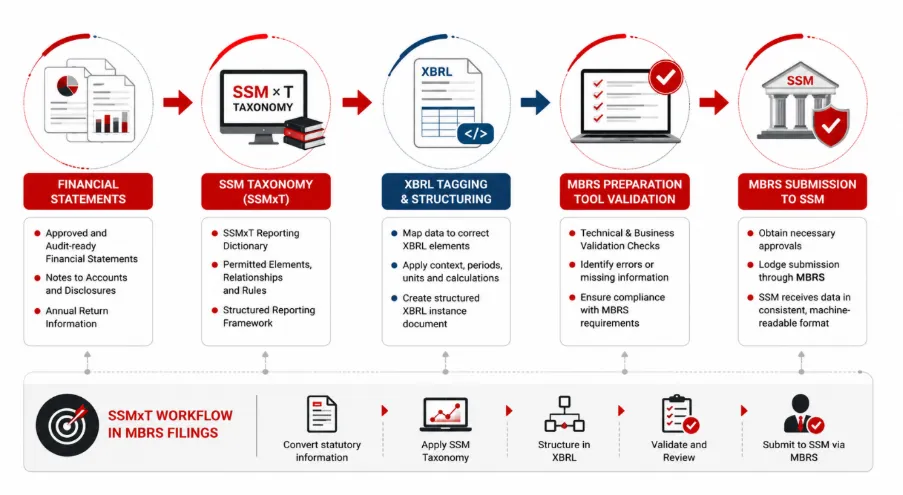
MBRS is not a document-upload portal in the usual sense. Filing involves preparing structured XBRL data, validating it in the MBRS Preparation Tool, obtaining the necessary approvals and lodging the submission through the proper channel.
A correct PDF does not automatically create a correct XBRL filing. The approved financial statements remain the source document, but the XBRL version needs accurate mapping. A tag may look plausible while still being wrong because the accounting concept, context, date, sign, unit or disclosure relationship has been selected incorrectly.
For firms handling multiple entities, those errors create a familiar operational problem: a rejected or failed validation result, a request to revise the file, repeated client follow-up and pressure close to the filing deadline. The purpose of SSMxT is to standardise the reporting structure. The challenge is applying that structure correctly to each company's facts.
The Main Parts of an SSMxT XBRL Filing
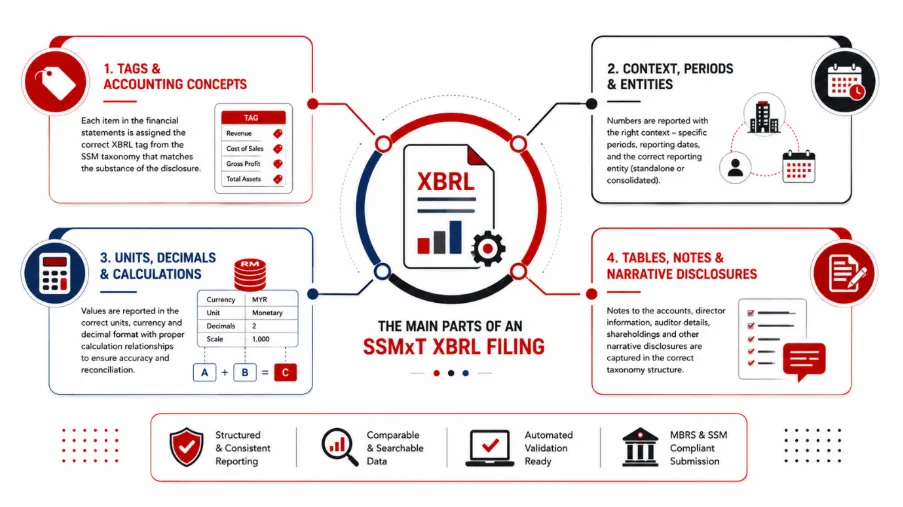
An XBRL filing is more than a spreadsheet of numbers. It combines factual data with the context that gives each fact meaning. In practice, a compliant MBRS submission commonly depends on four connected areas.
Tags and Accounting Concepts
Each reportable item is assigned an XBRL tag from the SSM taxonomy. The selected tag should match the substance of the disclosure, not merely the wording used in the accounts.
For example, a balance presented under trade and other receivables may need separate tagging for its components if the financial statements disclose them separately. Using one broad tag where the taxonomy expects detailed information can affect completeness. Equally, splitting information unnecessarily can create inconsistencies between totals and notes.
Context, Periods and Entities
Numbers need a reporting context. A statement of financial position amount is generally reported at a specific date, while profit or loss figures relate to a period. The file must also identify the correct reporting entity and, for group accounts, distinguish consolidated information from separate-company information where required.
This is one reason consolidated filings require careful handling. The same label may appear in both company and group columns, but each fact needs the correct entity and period context. A technically valid file can still misrepresent the accounts if these contexts are mixed up.
Units, Decimals and Calculations
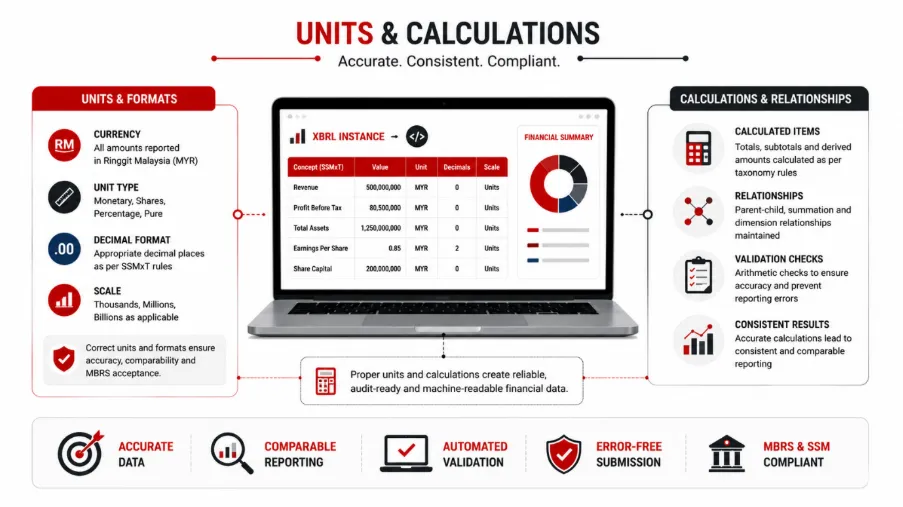
The taxonomy also governs whether an item is monetary, a percentage, a number of shares, a date or text. Amounts must use the proper currency and reasonable decimal treatment. Calculation relationships should reconcile where the taxonomy provides them.
Small presentation choices can matter. If the accounts are stated in RM'000 but the XBRL facts are entered as full ringgit without the proper scaling, the filing can be materially wrong despite appearing internally consistent.
Tables, Notes and Narrative Disclosures
SSMxT captures more than primary statements. Depending on the applicable template and filing requirements, the XBRL file may include notes to the accounts, directors' information, auditor details, shareholdings and other narrative disclosures.
Narrative tagging requires judgement. It is not a reason to force every sentence into a narrow tag. The aim is to preserve the required disclosure in the taxonomy structure while ensuring the final filing agrees with the signed or approved source documents.
MFRS, MPERS and the Right Reporting Template
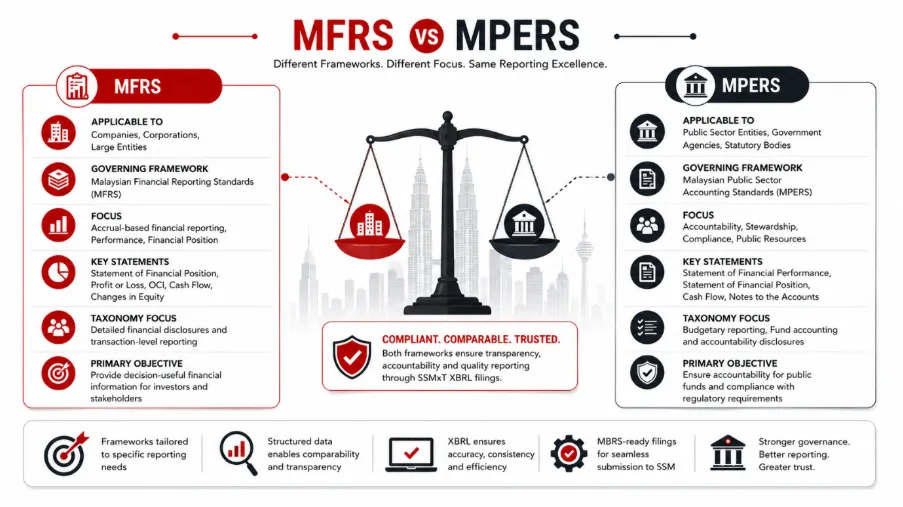
The accounting framework used by the company affects the content and presentation of its financial statements. A company preparing under Malaysian Financial Reporting Standards (MFRS) may have different disclosures from an entity using the Malaysian Private Entities Reporting Standard (MPERS). The SSMxT workflow must reflect that distinction.
The correct template and entry points should be selected before detailed tagging begins. Starting with the wrong template often creates avoidable rework later, especially where disclosures, statement formats or mandatory sections differ.
There is no sensible shortcut of copying a prior-year XBRL file without review. Prior-year data may be useful as a reference, but changes in accounting policies, share capital, directors, group structure, comparative figures or the applicable taxonomy version can all affect the current-year filing.
What MBRS Validation Does — and Does Not — Confirm
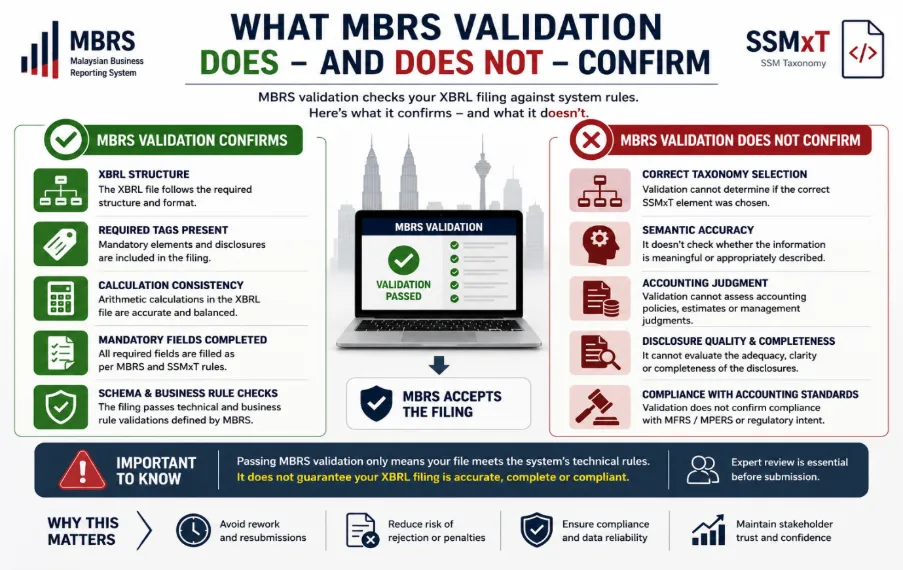
The MBRS Preparation Tool is a critical control point. It checks whether the XBRL package meets the system's technical and business validation rules before filing. This can identify missing required information, invalid dates, inconsistent calculations, improper contexts and other filing issues.
However, passing validation is not the same as confirming that every tag is semantically correct. The tool can confirm that a value has been entered in an acceptable structure. It cannot always determine whether the selected concept is the most accurate reflection of the audited financial statement.
That is why a proper review should compare the XBRL output against the final approved documents. The review should focus on company particulars, reporting periods, statement totals, comparative figures, director and auditor information, key notes, and whether the correct standalone or consolidated basis has been used.
A Practical SSMxT Preparation Workflow
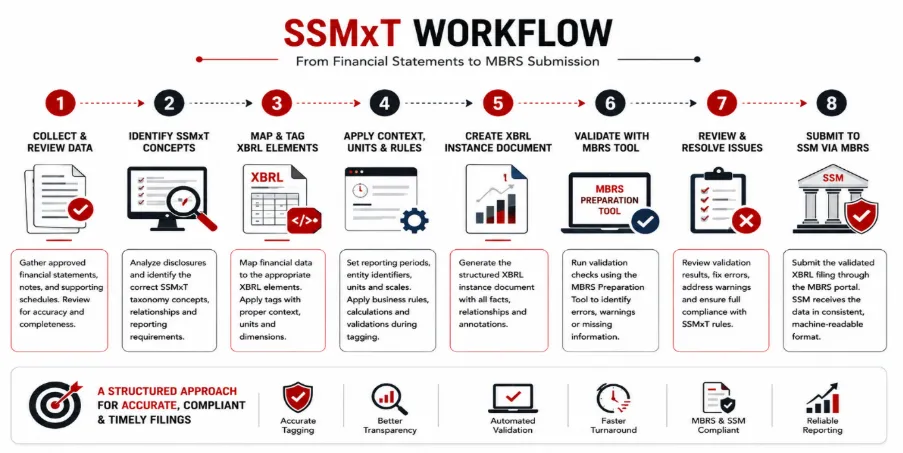
A controlled workflow reduces both technical risk and client chasing. First, confirm the filing type, financial reporting framework, financial year end and whether the accounts are standalone or consolidated. Obtain the final signed or approved financial statements and relevant annual return information before tagging starts.
Next, convert the source information into the appropriate SSMxT structure. The preparer maps each required disclosure, applies the relevant contexts and units, and checks that statement totals and note disclosures agree with the source document.
The file is then validated using the MBRS Preparation Tool. Validation errors should be resolved at source, rather than patched without checking the surrounding facts. Once the file passes technical checks, the client or authorised reviewer should approve the output before lodgement.
For deadline-sensitive filings, clear ownership is essential. Decide early who provides the final documents, who confirms factual details, who approves the XBRL output and who performs the MBRS lodgement. This is particularly important for accounting firms and corporate secretarial practices managing several entities at once.
Common SSMxT Mistakes That Cause Rework
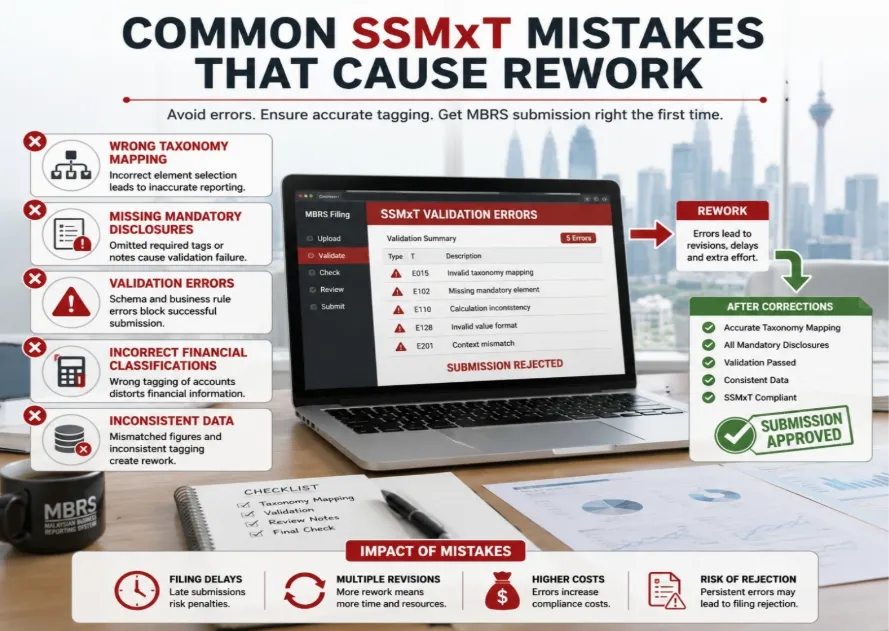
Most rework is preventable. It usually comes from treating XBRL as a final formatting task instead of a structured compliance process.
Common issues include:
- Using draft accounts rather than the final version
- Selecting the wrong reporting period
- Omitting comparative information
- Applying group data to a company-only context
- Failing to update prior-year tags for changed disclosures
Another frequent issue is a mismatch between the XBRL file and the accompanying statutory documents. Differences in directors' names, audit details, dates, rounding or statement totals can delay review even where the file technically validates.
The safest approach is to keep one approved source of truth and use a documented review process. Where internal capacity is limited, outsourcing specialised XBRL production can protect the filing timetable while leaving final approval with the company or professional firm.
When Specialist XBRL Support Is Worth Using
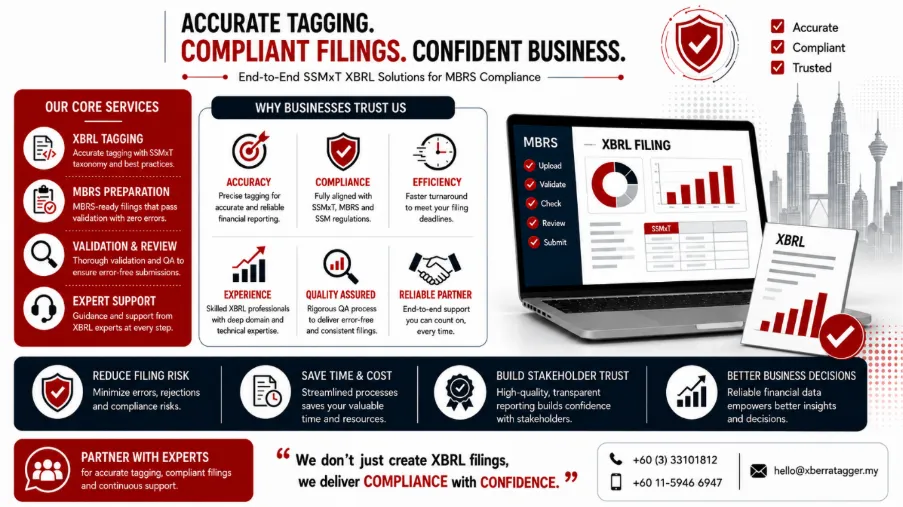
Specialist support is particularly useful for consolidated financial statements, first-time MBRS filers, entities with complex notes, and practices with high filing volumes. It can also be the more efficient option when an internal team understands the accounts but does not want to maintain detailed expertise in SSM taxonomy mapping and MBRS technical checks.
Xberra Tagger supports the conversion, validation and filing workflow for financial statements and annual returns, including MFRS, MPERS, standalone and consolidated reporting. The working principle is simple: secure document handling, transparent scope, accurate tagging, validation before submission and review control retained by the client.
SSMxT is best treated as part of the statutory filing process from the moment the accounts are finalised, not as a task to leave until the deadline. With the right source documents, the right template and a disciplined validation and review process, MBRS filing becomes a controlled compliance activity rather than a last-minute technical risk.
If you want accurate, fast, and compliant SSM Taxonomy based MBRS 2.0 filing, working with experts can save time, cost, and stress.
Need help with XBRL tagging services in Malaysia ?
Looking for MBRS 2.0 filing support?
Frequently Asked Questions
SSMxT is the official XBRL taxonomy used by Suruhanjaya Syarikat Malaysia (SSM) for MBRS filings. It standardises financial statement data so submissions are consistent, machine-readable and compliant with regulatory requirements.
Accurate XBRL tagging ensures that financial information is mapped correctly to the SSM taxonomy. Incorrect tagging can lead to validation errors, rejected submissions or additional review before filing.
No. MBRS validation checks technical compliance with the filing rules, but it does not confirm that every taxonomy concept has been selected correctly. A manual review is still essential.
MFRS and MPERS use different reporting frameworks and disclosure requirements. Selecting the correct reporting template is essential to ensure accurate SSM Taxonomy mapping and successful MBRS submission.
Outsourcing is beneficial for first-time MBRS filings, consolidated financial statements, complex disclosures and organisations handling multiple statutory filings, helping reduce errors and meet submission deadlines.
Simplify Your SSM Taxonomy (SSMxT) and MBRS Filing Process
Avoid validation errors, incorrect taxonomy mapping and last-minute filing delays. Xberra Tagger provides accurate XBRL tagging, thorough validation and reliable MBRS submission support for MFRS, MPERS, standalone and consolidated financial statements.