
MFRS vs MPERS: Which Reporting Standard Applies to Your Company?
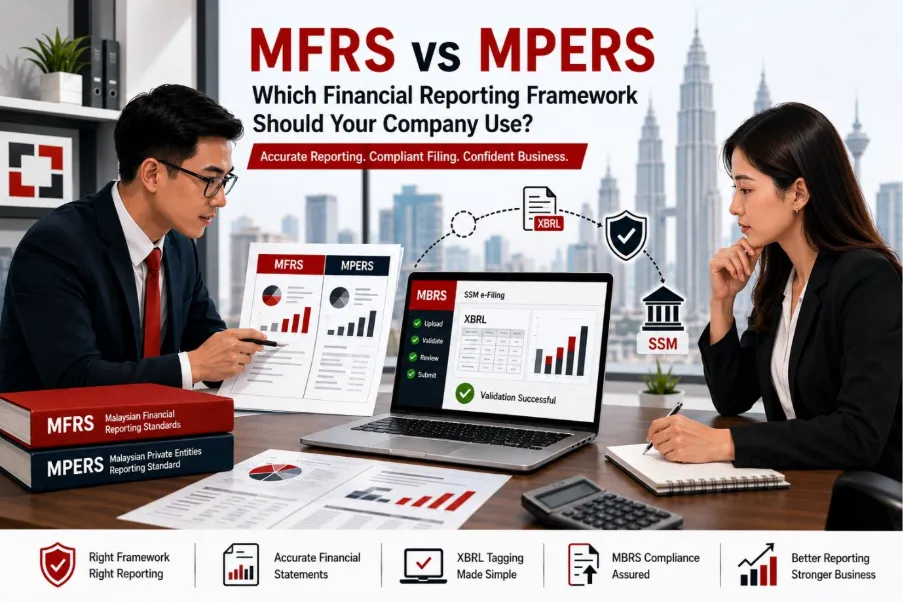
A wrong financial reporting framework can create more than an accounting correction. It can hold up account finalisation, trigger rework during review and complicate your SSM MBRS submission. For companies, accountants and corporate secretaries comparing MFRS vs MPERS Malaysia, the practical question is straightforward: which framework is your entity allowed — and required — to use?
The answer depends on the entity’s legal status and public accountability, not simply its turnover, number of employees or management preference. Establish this before accounts are drafted and before XBRL tagging begins. It protects the filing timetable and prevents expensive last-minute amendments.
MFRS vs MPERS Malaysia: The Core Difference
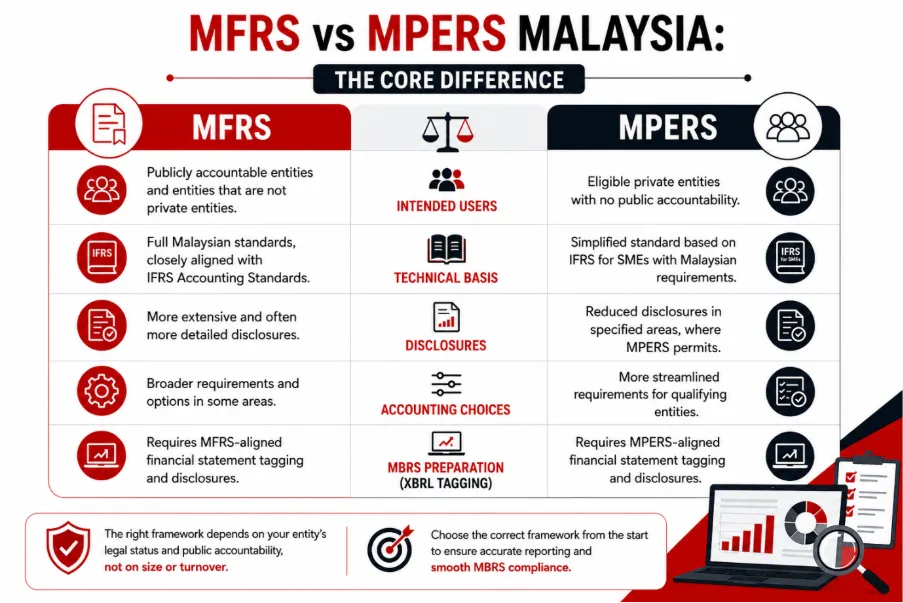
Malaysian Financial Reporting Standards (MFRS) are Malaysia’s full financial reporting standards. They are substantially aligned with IFRS Accounting Standards and are designed for entities with public accountability or entities that do not qualify as private entities under the applicable reporting framework.
Malaysian Private Entities Reporting Standard (MPERS) is a separate, simplified framework for eligible private entities. It is based on the IFRS for SMEs standard, with Malaysian requirements incorporated where relevant. It reduces certain disclosure and measurement demands while retaining a disciplined basis for preparing general-purpose financial statements.
Neither framework is a lighter or heavier version that a company may select purely for convenience. The right choice follows the entity’s eligibility. Once selected, that framework affects the accounting policies, disclosures, financial statement presentation and XBRL taxonomy elements used for MBRS preparation.
| Area | MFRS | MPERS |
|---|---|---|
| Intended users | Publicly accountable and non-private entities | Eligible private entities |
| Technical basis | Full Malaysian standards, closely aligned with IFRS | Simplified private-entity standard, based on IFRS for SMEs |
| Disclosures | More extensive and often more detailed | Reduced in specified areas, where MPERS permits |
| Accounting choices | Broader requirements and options in some areas | More streamlined requirements for qualifying entities |
| MBRS preparation | Requires MFRS-aligned financial statement tagging | Requires MPERS-aligned financial statement tagging |
Which Entities Normally Use MFRS?
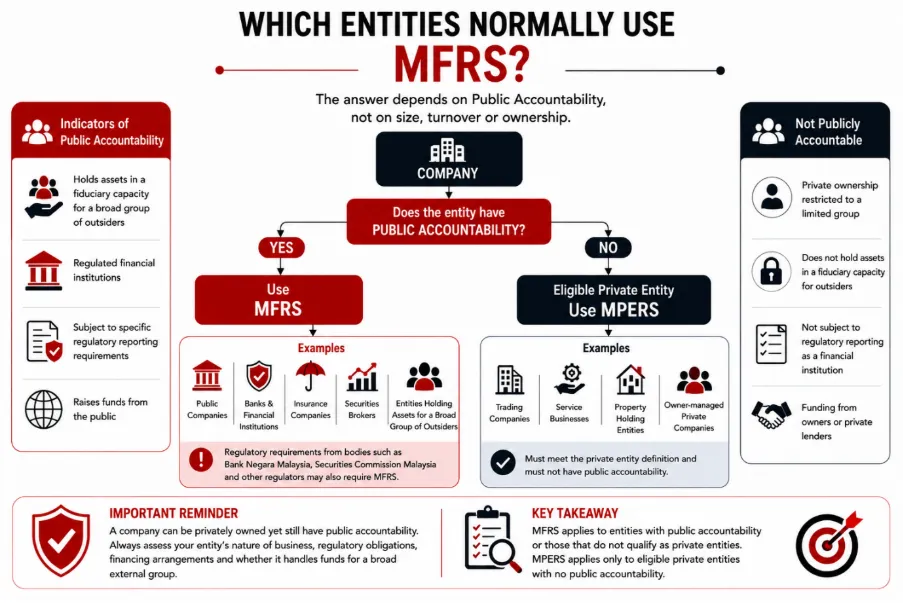
MFRS generally applies to entities that are not private entities for financial reporting purposes. This commonly includes public companies and entities with public accountability.
Public accountability is not limited to being listed on Bursa Malaysia. An entity may be publicly accountable where it holds assets in a fiduciary capacity for a broad group of outsiders as a primary business activity. Banks, insurers, securities brokers, unit trust managers and similar financial institutions are familiar examples. Regulatory requirements from bodies such as Bank Negara Malaysia or the Securities Commission Malaysia may also affect the reporting basis.
A company can be privately owned yet still fall outside MPERS eligibility. This is why the phrase ‘our company is Sdn. Bhd.’ is not, on its own, a complete answer. Corporate secretaries and finance teams should assess the entity’s nature of business, regulatory obligations, financing arrangements and whether it handles funds for a broad external group.
MFRS may also be operationally appropriate within a group where the parent prepares MFRS consolidated financial statements. However, group convenience should be assessed alongside the subsidiary’s own statutory reporting position. Do not assume that a group reporting package automatically determines the statutory framework for every entity.
When Can a Company Use MPERS?
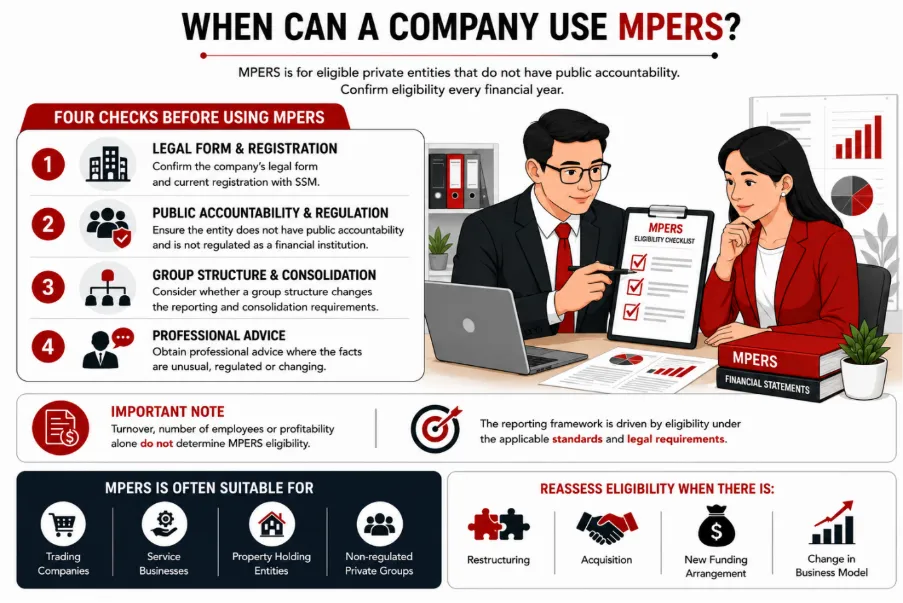
MPERS is intended for eligible private entities. In practical terms, the company must meet the relevant private-entity definition and must not have public accountability. Its financial statements should be prepared for general-purpose users such as shareholders, lenders, trade creditors and other stakeholders who cannot demand customised reports.
MPERS is often suitable for owner-managed trading companies, service businesses, property-holding entities and many non-regulated private groups. Yet eligibility should be confirmed each financial year, particularly after a restructuring, acquisition, new funding arrangement or change in business model.
Four checks are worth completing before finalising the accounts:
- Confirm the company’s legal form and current registration details
- Review whether the entity has public accountability or is regulated as a financial institution
- Consider whether a group structure changes the reporting and consolidation requirements
- Obtain professional advice where the facts are unusual, regulated or changing
Turnover thresholds are frequently raised in discussions about MPERS, but turnover alone is not the decision-maker. The reporting framework is driven by eligibility under the applicable standards and legal requirements. A profitable company with substantial revenue may still qualify for MPERS, while a smaller entity with public accountability may not.
The Accounting Differences That Affect Your Financial Statements
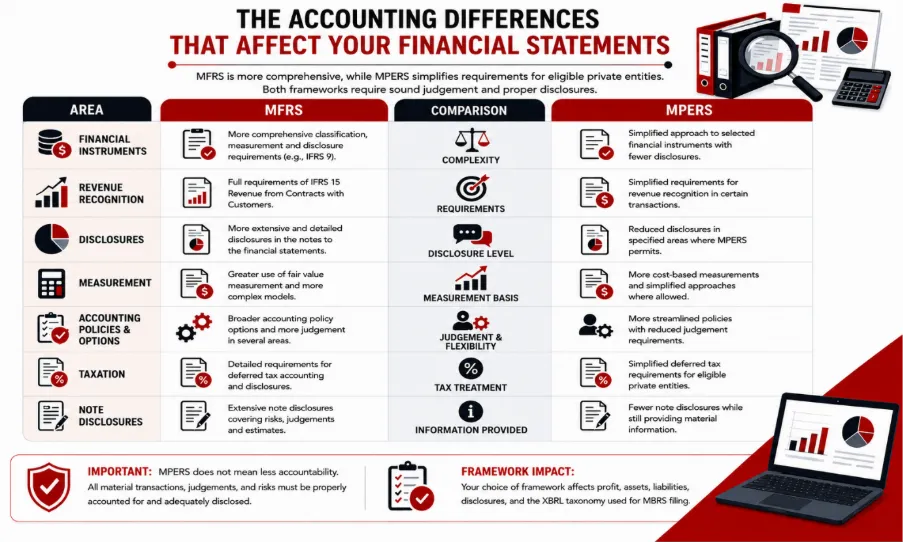
The practical impact of MFRS and MPERS is most visible once the accounts are being prepared. Different recognition, measurement and disclosure requirements can affect reported profit, assets, liabilities and note disclosures.
MFRS is more comprehensive. It includes detailed requirements for areas such as financial instruments, revenue, business combinations, fair value measurement, impairment and deferred tax. It is often necessary where users need extensive, comparable information or where the entity’s transactions are more complex.
MPERS reduces complexity in several areas. For example, it uses a more simplified approach to selected financial instruments and generally requires fewer disclosures. It can reduce the time required to prepare notes for an eligible private company, but it does not mean the accounts can be prepared casually. Related-party disclosures, going concern assessments, asset impairment, provisions, revenue recognition and tax remain material areas that require sound judgement and supporting records.
The differences become particularly important when a company changes framework. Moving from MPERS to MFRS, or from MFRS to MPERS where permitted, is not a simple label change on the cover page. Opening balances, comparative figures, accounting policies and transition disclosures may need review. Build enough time into the year-end timetable for the accountant and auditor to complete that work before MBRS submission is due.
Consolidated Accounts: Do Not Treat Them as a Routine Extension
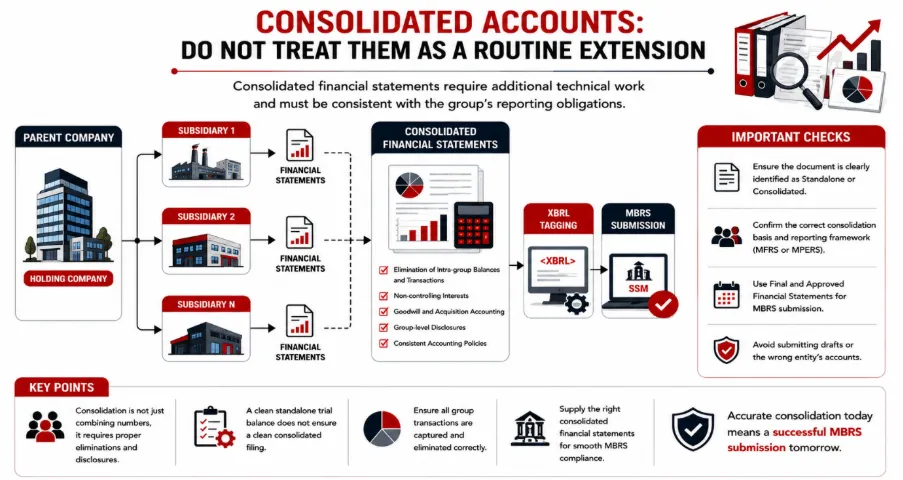
For groups, the MFRS vs MPERS assessment may involve both entity-level and group-level considerations. A holding company may need consolidated financial statements where it controls subsidiaries, subject to any applicable exemption. The framework used for consolidation must be consistent with the group’s reporting obligations and transactions.
Consolidated accounts add technical work that is not visible in a standalone set: elimination of intra-group balances and transactions, non-controlling interests, goodwill, acquisition accounting and group-level disclosures. A clean standalone trial balance is therefore not enough to guarantee a clean consolidated filing.
For MBRS purposes, ensure that the document supplied for XBRL conversion is clearly identified as standalone or consolidated, final and approved for submission. Sending an earlier draft, the wrong entity’s accounts or a standalone version in place of consolidated accounts creates avoidable revision cycles.
What the Framework Means for SSM MBRS and XBRL Tagging
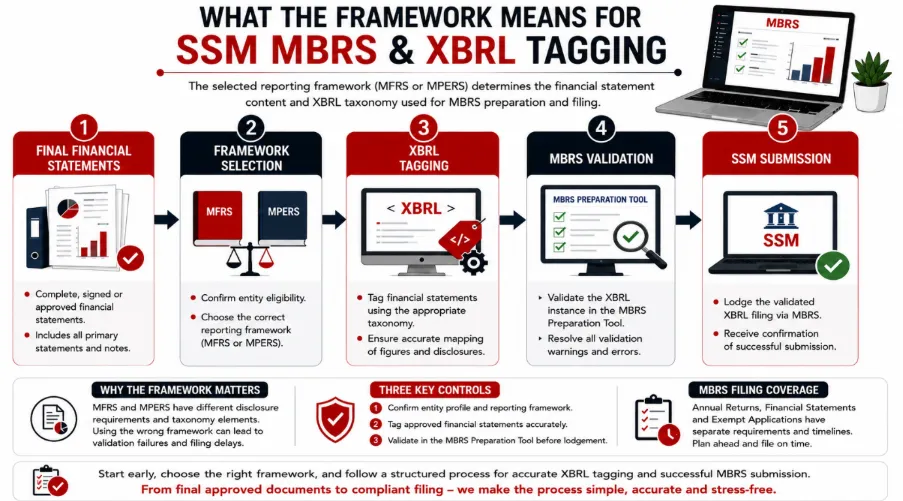
SSM MBRS requires financial statement information to be prepared and lodged in the required digital format. XBRL tagging converts the figures and disclosures in approved financial statements into the relevant taxonomy-based data. The selected reporting framework matters because the financial statement content and applicable taxonomy concepts differ between MFRS and MPERS reporting.
Tagging should begin only when the accounts are materially final. The XBRL preparer needs a complete signed or approved financial statement set, including the statement of financial position, profit or loss and other comprehensive income where applicable, changes in equity, cash flows and notes. For group entities, the correct consolidation basis must be evident.
A dependable workflow has three controls. First, confirm the entity profile and reporting framework. Second, tag the approved financial statements against the appropriate MBRS requirements. Third, validate the output in the MBRS Preparation Tool before lodgement. Validation identifies technical inconsistencies, but it cannot correct an underlying accounting decision or a wrongly selected framework.
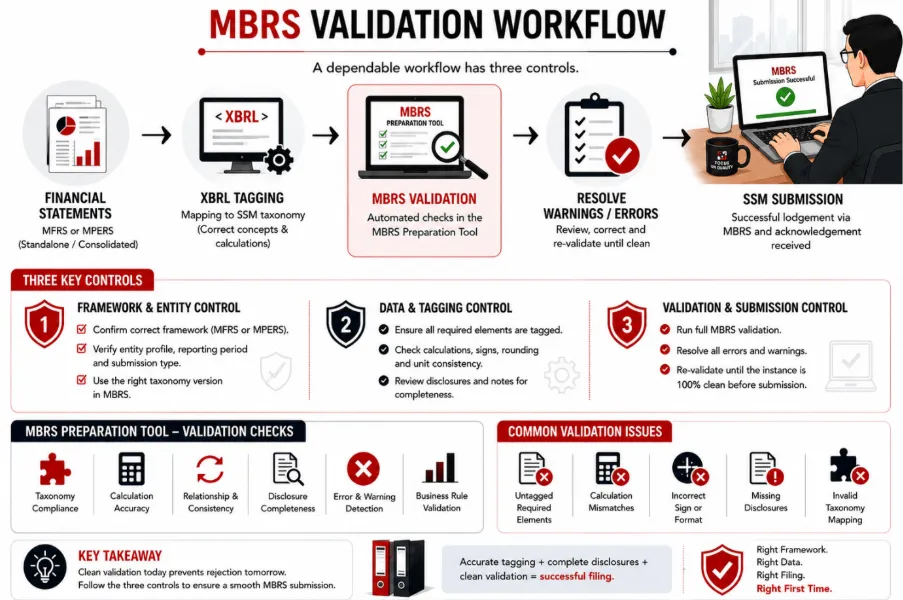
Annual returns, financial statements and exempt applications have separate filing requirements and timelines. Finance teams should not wait until the annual return deadline to start assessing the accounts. Allow time for audit completion where applicable, director approval, document review, XBRL conversion, validation and any SSM filing actions.
A Practical Pre-Filing Checklist
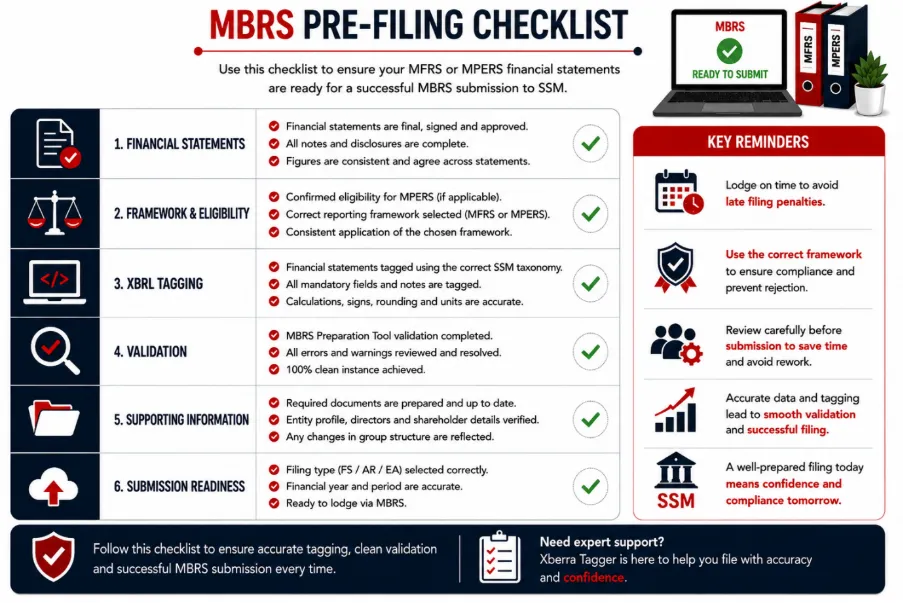
Before handing over documents for MBRS preparation, confirm that the company name and registration number match SSM records, the financial year end is correct, the directors’ report and financial statements are final, and the reporting framework is stated consistently throughout the accounts. For audited companies, ensure the auditor’s report and all notes are included in the final PDF.
Also check whether the financial statements are standalone or consolidated, whether comparative figures have been restated, and whether any material events after the reporting period require disclosure. These points are often the source of follow-up questions because they affect both the presentation of the accounts and the XBRL data structure.
Where internal capacity is tight, Xberra Tagger can prepare, validate and support the filing of MFRS and MPERS financial statements through MBRS from final approved documents. The aim is simple: accurate tagging, clear review control and no uncertainty over the technical submission steps.
The most effective time to resolve MFRS or MPERS eligibility is before year-end accounts are drafted. Once the framework, document set and filing route are clear, MBRS preparation becomes a controlled compliance task rather than a deadline risk.
Frequently Asked Questions About MFRS vs MPERS
MFRS is the full Malaysian Financial Reporting Standards framework, while MPERS is designed for eligible private entities. The correct framework depends on the company's eligibility and public accountability, not its size or turnover.
No. A company cannot select the reporting framework based on preference. It must meet the eligibility requirements for MPERS; otherwise, it is generally required to prepare financial statements under MFRS.
The selected reporting framework determines the financial statement structure and the XBRL taxonomy used for MBRS submission. Using the wrong framework can result in incorrect tagging, validation errors, and filing delays.
Yes. MBRS uses different taxonomy elements based on whether the financial statements are prepared under MFRS or MPERS. Accurate framework selection ensures correct XBRL tagging and successful validation.
Xberra Tagger provides professional XBRL conversion, MBRS validation, and SSM filing support for both MFRS and MPERS financial statements. The service helps reduce filing errors, improve compliance, and simplify the entire submission process.
Yes, a company may need to change its reporting framework if it no longer meets the eligibility requirements for MPERS or chooses to adopt MFRS where permitted. The change can affect accounting policies, opening balances, comparative figures and disclosures, so the transition should be assessed before preparing the financial statements.
Choose the Right Financial Reporting Framework with Confidence
Whether your company prepares financial statements under MFRS or MPERS, accurate XBRL tagging and MBRS filing are essential for a smooth SSM submission. Xberra Tagger helps businesses, accounting firms, and corporate secretaries convert approved financial statements into compliant XBRL files with expert validation and filing support.